Landscaping Trees are used widely in gardens and parks and serve a number of purposes.
Trees used for landscape design may be selected for the shade they provide, for the flowering attributes, for fall colour for general shape and form and even for the colour and texture of the bark of some tree.
Landscaping trees serve many purposes including providing a sense of scale to landscape design.
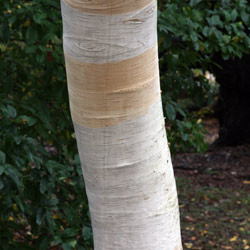
The fascinating trunks of trees such as Betula jacquemontii (above picture right) can be used very effectively in the landscape, grown next to a path so that the texture of the trunk is a feature, or perhaps in a group of three at the back of the garden border, many ‘Silver Birch’ species and cultivars make excellent landscaping trees.
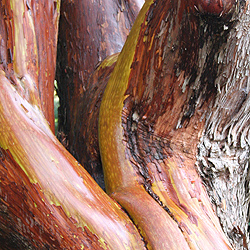
Arbutus x andrachnoides has a very different look, a fascinating textures trunk for impact in the landscape.
Trees form the backbone of many garden designs, they are usually the largest component and can be expensive if you with to create an instant impression by planting established trees in a newly landscaped area.
Trees form the backbone of many garden designs, they are usually the largest component and can be expensive if you with to create an instant impression by planting established trees in a newly landscaped area.
Uses of trees in landscape design
Selection of trees for landscaping will present a number of questions related to the purpose and function of the trees in the landscape.
In general landscaping trees are used for a number purposes ans it is essential to determine the design or practical features that you wish to add to the garden, these include :
- Ornamental and Flowering
- Evergreen or Deciduous
- Is a Shade Tree required
- Is this a ‘Structural Tree’ a design focus?
- Large or small growing
- Chosen for foliage or shape
- Is the bark and trunk a feature?
Shade Trees are important in the landscape for a number of reasons, they provide shade for outdoor areas, they provide a cooling effect by shading a part of a house or they may provide protection for other plants in the garden from hot afternoon sun.
Flowering Trees are used as features, and although they may only be in flower for a few weeks the effect can be magnificent in any landscape, flowering cherry trees, crab apples and flowering pears are all popular. Magnolias are a fantastic flowering tree for almost any garden.
Ornamental trees are often used along paths and driveways to create a magnificent entry to a property. Groups of trees with interesting trunks such as silver birches can be planted in groups where their trunks and gleaming white bark are a feature.
Trees with interesting bark such as Arbutus species and Coral Bark and Paper Bark Maples can be a feature next to path.
Evergreen trees in the landscape can be used as screens or windbreaks, many conifer make fantastic windbreaks and evergreen magnolias can make excellent screening plants.
Trees chosen for Fall color are another group that deserve special attention, Maples, Oaks and many others can provide a riot of color in the landscape.
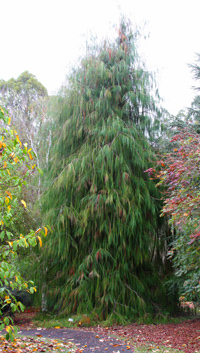
Chamaecyparis lawsoniana imbricata pendula with its pendulus foliage makes an interesting addition to the landscape positioned on the curve of a path for maximum impact
Consider the growing habit of trees in the landscape, do you require a spreading tree with a large crown or a columnar tree with a very upright growing habit?
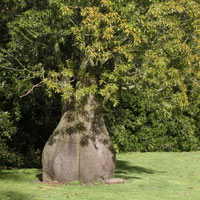
If you are looking for something really different pictured below is Brachychiton rupestris or ‘Queensland Bottle Tree’, with a fascinating swollen trunk that would be a feature in any landscape.
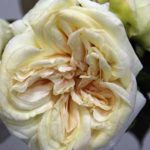
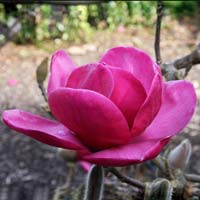
If its flowers you are after Magnolias such as Magnolia Felix (pictured left) are an outstanding landscaping tree, with both deciduous and evergreen varieties, they make a great feature tree in a lawn or in the garden border.
Trees Add Value to Your Property
A few well chosen trees not only look good, they can also add value to your property.
Not all trees used in landscaping are green, the blue foliage of Cedrus atlantica glauca fastigiata is one of the many conifers with blue foliage that make an impact in the larger landscape.
Flowering Crabapple Trees are another great tree for the landscape, Malus baccata Manchurica or Manchurian Crabapple is one on many species and cultivars worth looking for.